
Slocum Chiropractic use case
From a Digital Business Plan to 2.5× more new patients.
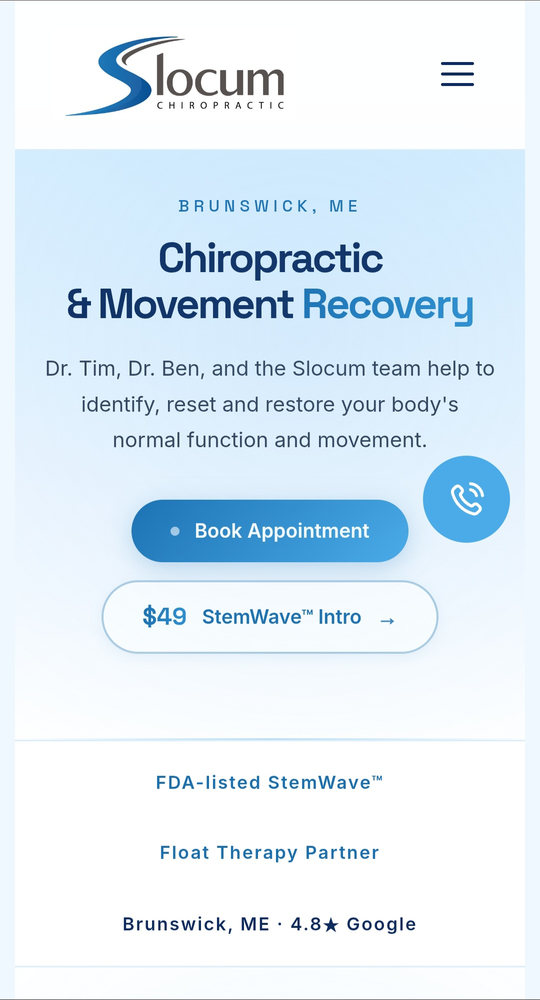
Slocum Chiropractic came to us looking to create more capacity at the front desk, capture more new-patient opportunities, and modernize a business that had outgrown its existing systems.
New patients per week in the first 2 months
Based on the practice's reported new-patient volume.


The starting point
The problem wasn't one broken system.
Slocum Chiropractic had a collection of challenges that were beginning to compound.
The front desk was spending significant time handling repetitive requests.
After-hours calls frequently ended without a message.
Patient forms and appointment requests weren't designed around the current patient journey.
The website and brand still reflected a legacy identity from an acquisition several years earlier.
At the same time, the practice wanted to get back toward 20–25 new patients per month while reducing cancellations and creating the capacity to support future growth.
The question wasn't simply, “What can we automate?”
It was: where is the business losing time and opportunity, and what would it take to change that?
The Digital Business Plan
We didn't start by building anything.
We started with a Digital Business Plan.
We reviewed the practice's existing technology, patient journey, website, search presence, front-desk workload, and opportunities for growth.
The goal was to understand the business before deciding what technology belonged in it.
Digital Business Plan
Slocum Chiropractic
We looked at:
- 01
Patient acquisition
Where new-patient opportunities were coming from, and where they were being lost.
- 02
Patient intake
What happened between the first inquiry and the first appointment.
- 03
Front-desk capacity
Where staff time was being consumed by repetitive work.
- 04
Digital presence
Website, Google Business Profile, search visibility, accessibility, and trust signals.
- 05
Growth opportunities
What could help the practice support more patients without simply adding more work.
The result was a roadmap for where technology could create capacity.
Not a list of tools looking for somewhere to go.
What we built
The plan became a new operating layer for the practice.
01
Capture
More opportunities, including after hours.

02
Convert
Turn an inquiry into a prepared patient.

03
Create Capacity
Move repetitive work away from the front desk.

04
Build the Foundation
Modernize the digital side of the practice.

The first signal
Then the numbers started moving.
new patients / week
Before
new patients / week
After 2 months
That's a 2.5× increase in weekly new-patient volume in the first two months.
The practice's stated goal was to return to roughly 20–25 new patients per month.
The missed opportunities
The biggest change wasn't happening during business hours.
Over a three-week period:
new-patient opportunities came in after hours.
Previously
Many of those calls ended as missed calls or never resulted in a message.
Now
Those patients can have a conversation, provide information, receive next steps, and enter the practice's intake process, even when the front desk isn't there.
of after-hours calls now result in a conversation or message being captured.
The digital front door
The website became more than a website.
The old website wasn't designed around the way the practice wanted to attract and intake patients.
We rebuilt the digital front door around the patient journey, from discovering the practice to asking questions, requesting an appointment, completing forms, and hearing back from the practice.

Discover
Improved search visibility + refreshed Google presence
Engage
AI chat + voice interaction
Intake
Appointment requests + digital forms + next steps sent automatically
Beyond the first appointment
The work didn't stop at getting the patient through the door.
The same foundation is now being extended into reviews, social media, content, and ongoing optimization.
Next 8 weeks
Reviews
Past-patient review campaign
Google Reviews
Ongoing patient requests + approved responses
Social
Facebook & Instagram response handling
Content
Articles written to be found by Google and by AI search
What's changed
One project. Several changes.
Results
Two months in, the practice is moving in the right direction.
2.5×
Increase in new patients per week
3.7
New patients per week
67%
After-hours calls resulting in conversation/message capture
12 / 16
New-patient opportunities occurring after hours
And some results are still developing.
Cancellation rates have improved, but there isn't enough data yet to determine the long-term impact.
Website visibility continues to improve, and the practice is now appearing in AI search results for a relevant service where competing local practices aren't currently being referenced.
Monthly transcript analysis is also being used to continuously improve the receptionist's knowledge and conversations.
The business impact
More capacity changes what growth looks like.
The practice didn't simply need more patients.
It needed the capacity to handle more patients without making every additional opportunity dependent on another hour of front-desk labor.
~$1,800
Each new patient's annual client value.
$200,000+
In additional annual revenue, based on the extra new patients per week.
~4
Investment payback is four additional new patients...total.
The takeaway
This wasn't an AI receptionist project.
It started with a business problem.
We mapped the business, identified where time and opportunities were being lost, built a Digital Business Plan, and then implemented the pieces that could actually change those constraints.
The technology was the implementation.
The plan came first.

What could you change if your business had more capacity?
Every business has work that has to get done, and work that actually moves it forward.
The first step is figuring out which is which.